The Kitchen Scullery: A Room Between Kitchen and Yard
A kitchen scullery separated washing and preparation from cooking. Learn how its changing role can guide a useful purpose for the room in a rural home.
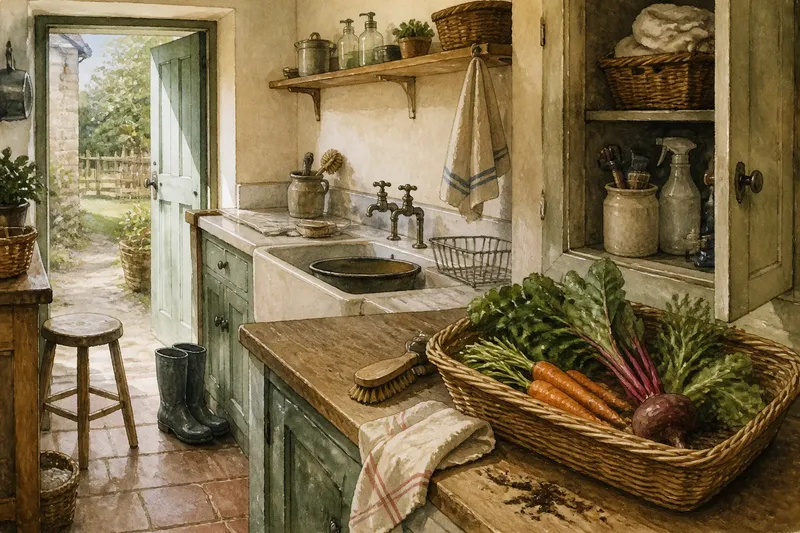
A kitchen scullery gave washing and preparation a place apart from cooking, though the precise arrangement depended on the house and household. In country homes, it might sit near a yard entrance or water supply, where produce, vessels and equipment could be handled before reaching the main kitchen. Its history is less a fixed blueprint than a record of how particular households organized work.
Why put scullery work in another room?
Cooking, washing and food preparation can compete for the same sink and surfaces. In some houses, a separate workroom let a household move wet or dirty tasks away from the main kitchen. A scullery might include a sink or wash tub, a draining surface, shelves and a place for cleaning materials, but its fittings varied with the building and its resources.
Its location often made practical sense: near water, an outside entrance, or both. That did not mean every scullery served the same purpose. One household might use it mainly for washing dishes; another might sort produce or handle laundry there. In a house without a separate room, those jobs could take place in a kitchen corner instead.
The division also had a social dimension. Work kept out of the main kitchen’s view could be treated as background to the household’s public life. That interpretation should not be mistaken for a universal rule: rooms, labor arrangements and expectations differed across places and periods. A separate room could contain work, not erase it.
Why does storage alone make a poor scullery plan?
A former scullery often becomes a default store because it is a spare room with shelves. The difficulty is not just the amount of stuff. Storage can occupy the very counter, sink access or floor space needed for the room’s other intended work. Once those surfaces are blocked, even a simple washing or sorting task requires moving unrelated objects first.
Start by naming the room’s main task. If it is for produce preparation, it needs a washable work surface and a place for clean containers. If it is for dishwashing, the sink and draining area need to remain usable. If the household wants both functions, mark where each begins and ends rather than expecting one surface to serve every purpose at once.
Use the room’s existing features to make the choice concrete. A shelf above a sink may suit drying supplies; a closed cabinet can keep cleaning products apart from food and dishes. If a proposed storage item blocks a work surface or makes the sink difficult to reach, move it elsewhere or choose a different storage location. The question is not whether the room can hold another object, but whether that object helps or obstructs its chosen task.
How did household changes alter the scullery?
As plumbing and household equipment changed, some rooms called sculleries took on other uses, such as pantry or utility storage. Others continued to support washing or food preparation. These changes were not uniform; a room’s later purpose depended on the house, its fittings and the people living there.
Tasks could also move into the main kitchen or another utility space. The room’s old name might remain after its original use changed, or disappear while some of its work continued elsewhere. That history is useful when considering an existing scullery: its position and fittings may suggest practical options, but they do not dictate a single correct use.
How can you decide what the room should do now?
Observe which task repeatedly needs a suitable surface, sink or storage place. Then compare that need with the room’s actual fittings. A room beside the kitchen with a deep sink may suit washing equipment; one with dry shelving and little counter space may function better as a pantry. Keep food, cleaning products and wet equipment appropriately separated.
Say a household has a former scullery beside its kitchen, with a sink, a small counter and a yard door. They want to sort garden vegetables there, but a box of spare jars and a basket of cleaning cloths cover the counter. They move the jars to a pantry shelf, place a washable basket and vegetable brush by the sink, and store the cloths in a separate cabinet. The resulting decision is clear: the counter is now available for produce, while the jars and cloths remain stored without occupying the work surface.
A scullery is a little like a kitchen drawer: it works best when its contents serve a recognizable purpose, not when it becomes the place for everything nobody has decided about.
Which kitchen scullery questions help clarify its role?
What was a scullery used for?
Depending on the house and household, it could support washing dishes, cleaning equipment, handling produce or other wet and messy work. There was no single arrangement or universal list of duties.
Is a scullery the same as a pantry?
Not necessarily. A pantry primarily stores food or serving supplies, while a scullery is associated with household work such as washing or preparation. A room could serve both functions, but the distinction helps explain why its surfaces and storage may be arranged differently.
Why might a scullery be near an outside door?
In some homes, a nearby entrance made it convenient to bring in produce or equipment for washing and preparation. The placement varied, so an outside door should be treated as a clue to the room’s use, not proof of one fixed history.
Can a scullery still be useful in a rural home?
Yes, if the room’s fittings and location suit a task the household actually does there. Washing equipment, sorting produce or storing suitable supplies are possibilities; the useful choice depends on the room and its users.
What does a scullery’s place in the house tell us?
A scullery makes one household choice visible: some homes placed particular kinds of work apart from cooking and shared kitchen activity. Its layout can reflect convenience, social expectations, or both, though the balance varied by household and period.
For a present-day kitchen scullery, the old name matters less than the fit between the room and its work. Choose a purpose that uses its actual sink, surfaces and location, then let those features guide what belongs there. That preserves the room’s practical character without pretending every country house followed the same plan.